
Software and workflow: from raw capture to a measurable exhibit
The scanner produces data. What makes it evidence is what happens next: registration, cleanup, measurement, export — and a record of every step.
Three areas below: the software itself, the point cloud workflow, and the path from scene to courtroom.
 No sensitive case details required.
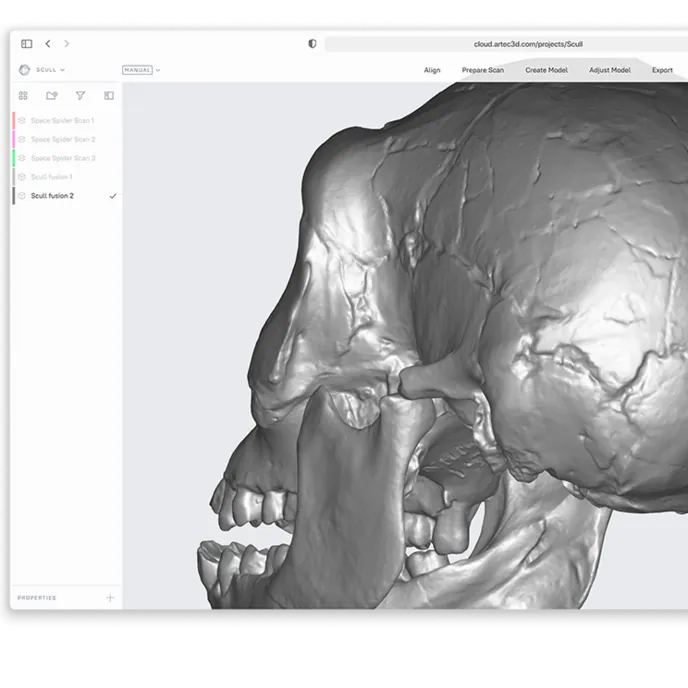
 Registration and fusionMultiple captures aligned into one dimensionally accurate model.
 Measurement and analysisDistances, areas, volumes, cross-sections and deviation, inside the model.
 Standard exportOBJ, PLY, STL, WRL, PTX, ASCII and E57 — no vendor lock-in.
 A reproducible recordSteps kept in the project and key parameters logged in the case notes, so the result can be re-derived.
Where in the pipeline are you?
The software, the point cloud work, and the whole path from first response to exhibit.
One dataset, every downstream tool
A forensic 3D workflow fails at the joins. If the capture cannot be registered reliably, or the output cannot be opened by the analysis package the laboratory has already validated, the scan becomes a second workflow that nobody maintains — and it is quietly dropped.
Artec Studio registers and refines the capture into a dimensionally accurate model, then exports the formats those packages read. The same dataset supports the initial documentation, the expert report and the courtroom presentation, without rescanning and without reconstruction from memory.
What the software has to do
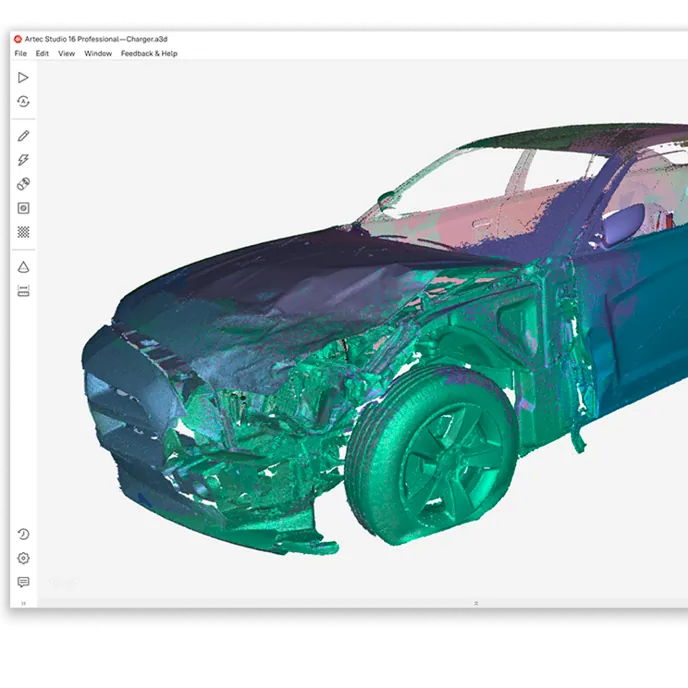
Align what was captured separately: Close-range detail registered into the wider scene, in one coordinate system.
Measure inside the model: Point-to-point, section, area and volume, with the result traceable to the file.

Share for review: Colleagues and experts open the model without specialist hardware.
Keep it where you put it: Processing runs on your own machines; cloud sharing is optional, not required.
See the processing workflow from raw scan to courtroom-ready export — book a demo.
Book a demoQuestions that come up first
What formats does Artec Studio export?
OBJ, PLY, STL, WRL, PTX, ASCII and E57 among others, so the data goes into the analysis, measurement and reconstruction software a forensic laboratory already uses. Your data is not tied to one vendor.
How long before an operator is productive?
Capture is learned in a day of hands-on training with an Artec partner; processing skills build over the first supervised cases. The handheld scanners show coverage on screen in real time, so an operator can see what has been captured while still at the scene.
Does the workflow need an internet connection?
No. Capture is written to the scanner (Leo, Ray II) or to the connected laptop (Spider II, Eva, Micro II) and processed on your own machines. Artec Cloud is available for sharing and review, but it is not a condition of scanning or processing.
Can measurements be reproduced by someone else?
That is the point of recording parameters and steps: another examiner opens the same file, repeats the measurement and compares. It is what makes the result checkable rather than a matter of opinion.
Other areas of forensic 3D work
Tell us about the work you do
A forensic application specialist will come back with the device that fits it, the accuracy to expect, and how the data reaches your existing case workflow.