
Crime Scene Investigation
One capture, taken before the scene is released, that answers questions nobody has asked yet. Every distance, surface and sightline stays measurable months later — without anyone returning to a scene that no longer exists.
Seven areas of crime scene work below, each with the accuracy, capture time and workflow that applies to it.
 No sensitive case details required.
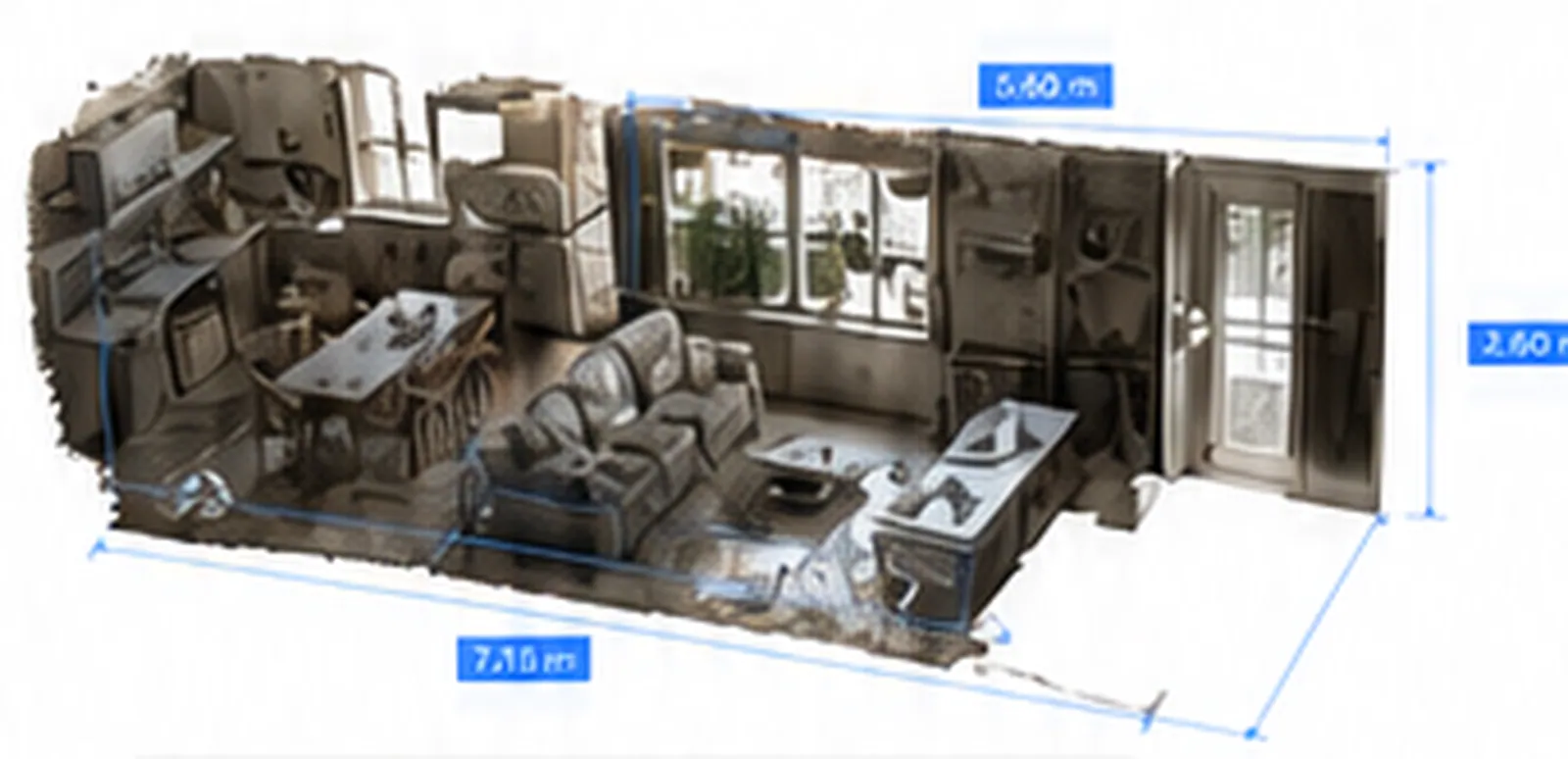
 Nothing is touchedNo markers or targets in the scene. Evidence is documented as found.
 The whole sceneRooms, buildings and street scenes, indoors or out, day or night.
 Measure after releaseAny point, distance, area or angle, once the scene is gone.
 Court-ready recordOne dataset from first response to the courtroom.
What do you need to document?
Crime scene work splits into jobs with different accuracy, range and time constraints. Pick the one in front of you.
Why the scene has to be measured, not photographed
A photograph records what a scene looked like from one position. It cannot settle how far the weapon was from the victim, whether a witness at the window could see the doorway, or how a stain pattern relates to the surface it sits on. Perspective compresses depth, and the defence knows exactly where that leaves a gap.
A scan records geometry instead of appearance. Two points that look adjacent in a photograph carry a real distance in a point cloud, and that distance can be produced in court years later. In a University of Toronto study, documenting 11 simulated injuries on a live participant took 26 minutes with Artec Eva against 54 for photography and manual measurement (processing done afterwards), and the model could be measured along curved skin. The National Institute of Justice identifies contactless capture as a key benefit for investigations: nothing has to be disturbed to obtain it.
Measured, not asserted
One capture, every downstream question
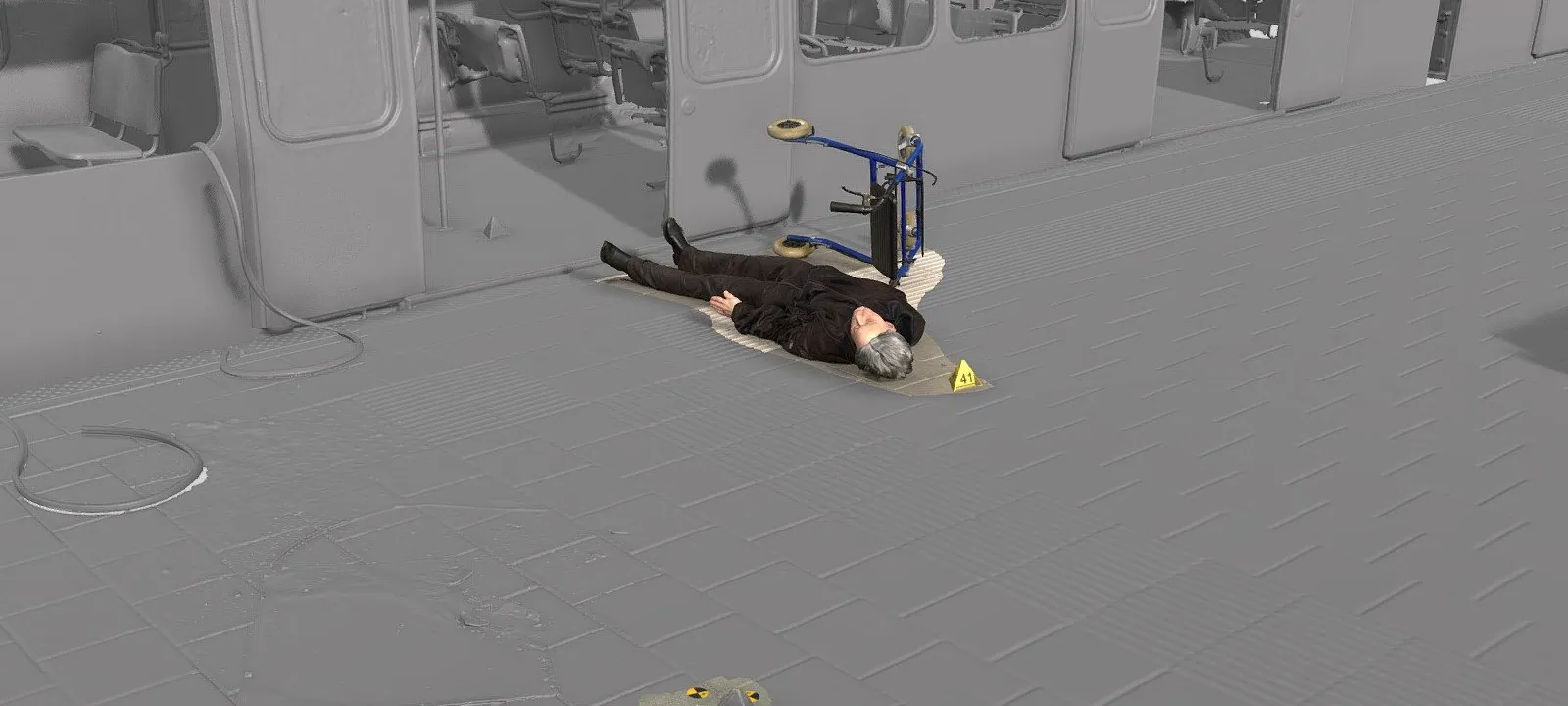

Measurements on demand: Point-to-point distances, areas, angles and cross-sections, taken from the archive rather than from a return visit.

Analysis by several teams: Scene examiners, pathologists, reconstructionists and prosecutors work from the same dataset instead of three incompatible sets of notes.

Courtroom presentation: A model the court can be walked through, built from the record rather than from recollection.

A documented method: Capture parameters, operator and processing steps recorded, so the result is reproducible under cross-examination.
A room needs range; a stain pattern needs sub-millimetre detail. Many units pair a long-range scanner with a handheld.
Compare forensic scanners“Artec has truly changed the face of forensic anthropology with Space Spider, Leo, and Ray. I’ve integrated Artec’s solutions into my daily field work as well as my regular and special classes for investigators, law enforcement officers, and college students, and the results have been nothing short of spectacular.”
“With Leo, we get highly accurate scans that provide more than enough geometry data for any analysis we need to conduct. And then you add in the photo texture to make it real.”
Questions that come up before the first scene
How long does scanning add to scene processing?
It replaces work rather than adding to it. A Ray II dome takes about 1.7 minutes without colour and 2.7 with it; a room typically needs two or three, and a body a few minutes more. Origin Forensics reports that vehicle inspection scans which took three to four hours with a tripod laser scanner take under one hour with Artec Leo; the team leaves confident the capture is complete, and processing follows at the office.
Will a 3D scan be admitted as evidence?
Scan models from Artec customers have been used in criminal cases, including a UK case where a scan-based report helped the defence and the defendant received a reduced sentence, and an NIJ-funded landscape study has compared the 3D crime scene scanning devices on the market. Admissibility still rests with the court, so operator qualification, validation and chain of custody all matter.
Does the scene need lighting?
Not for geometry. The scanners project their own structured or laser light, so Artec Ray II records the geometry of large indoor and outdoor scenes day or night; its colour imagery needs light on the scene. The handheld units work in low light at the scene.
Can we validate this against our current method?
Yes, and it is the sensible way in. Scan a known scene alongside your existing photography and measurement workflow, compare against your survey control, and write the comparison into your SOP before anything is replaced.
Other areas of forensic 3D work
Tell us about the scenes you process
A forensic application specialist will come back with the device that fits your scene types, the accuracy to expect at that range, and how the data reaches your existing case workflow.