
Handheld vs Terrestrial Scanner
A terrestrial scanner records the whole scene from a tripod. A handheld records what is in it at an order of magnitude more detail. Neither does the other's job well.
Many forensic units end up with both. The question is which to buy first — and that depends on what your unit documents most.
 No sensitive case details required.
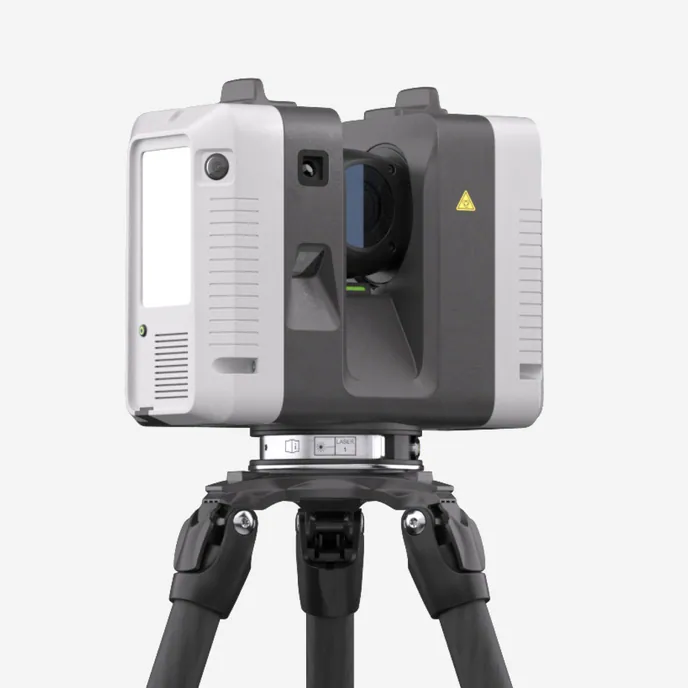
Handheld or terrestrial scanner for forensics?
Terrestrial for the scene — rooms, buildings, roads at up to 130 m range. Handheld for the evidence — bodies, vehicles, marks at 0.05–0.1 mm. Units documenting whole scenes start with the tripod; units documenting bodies and evidence start with the handheld.
How they compare
The two are compared on what actually decides the purchase.
| Terrestrial (Artec Ray II)Tripod laser scanner for the scene as a whole. | Handheld (Artec Leo)Wireless structured-light scanner for bodies, vehicles and evidence. | |
|---|---|---|
| Range | 0.5–130 m | Arm's length |
| Accuracy | 1.9 mm at 10 m | Up to 0.1 mm |
| Time per capture | About 1.7 minutes per position (2.7 with colour) | A body or a bullet hole in minutes |
| What it is for | Rooms, buildings, roads, outdoor scenes | Bodies, vehicles, evidence, marks, in position |
| Works where | Anywhere with a line of sight; geometry day or night, colour needs light | Wherever the operator can stand; no laptop, no cables |
| Choose this when | Buy first if the scene itself is the evidence — rooms, roads, structures. | Buy first if bodies, vehicles and evidence are what you document — then add the tripod. |
The two register into one dataset in Artec Studio: handheld detail sits in its measured place in the tripod scan.
Why the answer is usually both — and in what order
A terrestrial laser scanner and a handheld structured-light scanner solve different problems. The tripod scanner records a whole room, a building or a stretch of road from a few positions, at millimetre accuracy over tens of metres, without anyone walking through the scene. The handheld records a body, a vehicle, a wound or a toolmark at a tenth of a millimetre, from arm's length, in colour.
Try to do one job with the other and it fails. A tripod scanner cannot resolve a bite mark; a handheld cannot record a warehouse. Units that document scenes as a whole — homicide units, collision investigators — start with the tripod and add a handheld for evidence and vehicles. Units whose work is bodies and evidence — medical examiners, laboratories — start with the handheld and often do without the tripod.
When both are in use, they feed one project: Artec Studio registers handheld scans into the Ray II point cloud, so the detail is in its measured place in the scene.
See handheld and terrestrial scanning on one scene, and where each earns its place — book a demo.
Book a demoQuestions practitioners ask
Can a handheld scan a whole room?
It can, slowly, and it is the wrong tool. A tripod scanner records a room in minutes from a few positions; a handheld records what is in the room at an order of magnitude more detail.
Can a terrestrial scanner capture a body or a bullet hole?
It records their position at millimetre accuracy. It does not resolve the detail — a wound edge or a defect profile — that a handheld resolves at 0.05–0.2 mm.
Do the two datasets combine?
Yes. Artec Studio registers handheld scans into the Ray II point cloud so everything sits in one coordinate system.
Which should a small unit buy first?
Whichever matches what you document most. Whole scenes: the tripod. Bodies, vehicles and evidence: the handheld. Talk it through with a specialist rather than guessing.
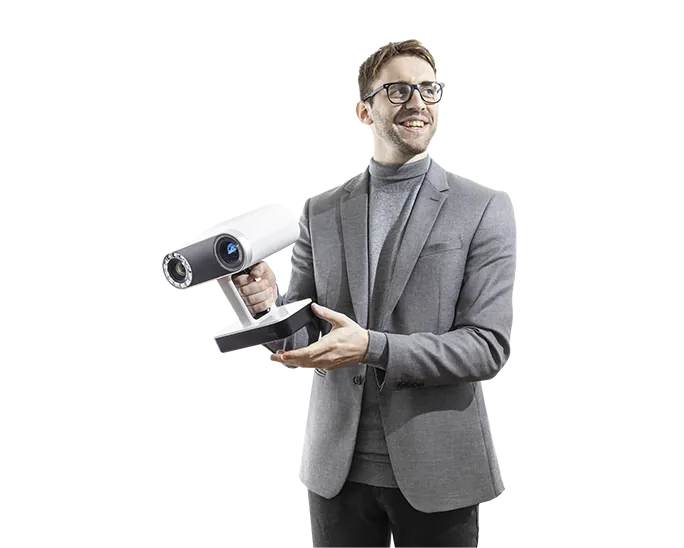
Tell us about the work you do
A forensic application specialist will come back with the device that fits it, the accuracy to expect at that scale, and how the data reaches your existing workflow.