
Professional Scanner vs Smartphone LiDAR
A phone with a LiDAR sensor produces a 3D model of a room in minutes. It is useful for a sketch. As a measurement, it needs its own validation.
The difference is not the picture on the screen — it is whether the number you read from it can be stated, cited and defended.
 No sensitive case details required.
Can a smartphone LiDAR scan be used as forensic evidence?
Only with its own validation. Phones publish no accuracy specification or calibration; independent studies report errors from a few millimetres to centimetres depending on app, scene and operator. Professional scanners state 0.05–0.1 mm handheld and 1.9 mm at 10 m on a tripod — a figure an expert can cite alongside the unit's own validation.
How they compare
Compared on what a cross-examiner will ask about.
| Professional scanner (Artec Leo, Spider II, Ray II)Purpose-built measuring instruments. | Smartphone LiDARA consumer depth sensor with an app. | |
|---|---|---|
| Stated accuracy | Yes: 0.05–0.1 mm handheld, 1.9 mm at 10 m tripod | None published; mm to cm in studies |
| Detail | 0.2 mm resolution, 0.1 mm accuracy on evidence and bodies | Coarse; no fine detail |
| Range | Arm's length to 130 m, by device | A few metres |
| Calibration and traceability | Calibrated devices, stated conditions | None from the manufacturer |
| Raw data and history | Raw scans and processing kept in the project | App-dependent; often a mesh only |
| Choose this when | The measurement, easier to defend because the figure is stated and the method documented. | A sketch or orientation aid; evidence only with a validated method. |
A phone scan is fine for a briefing. The moment a number from it matters, it needs a validated method behind it.
Where the phone stops being evidence
Smartphone LiDAR has made everyone a 3D scanner owner, and for orientation it is genuinely useful: a quick model of a room to brief a team is better than a sketch. The problem starts when someone reads a distance from it without a validated method. Consumer depth sensors have no published accuracy specification and no user calibration, and error can grow as the scanned area grows. Independent studies report results from a few millimetres to centimetres, varying by app, by scene and by how the phone was moved. The raw data is usually not retained.
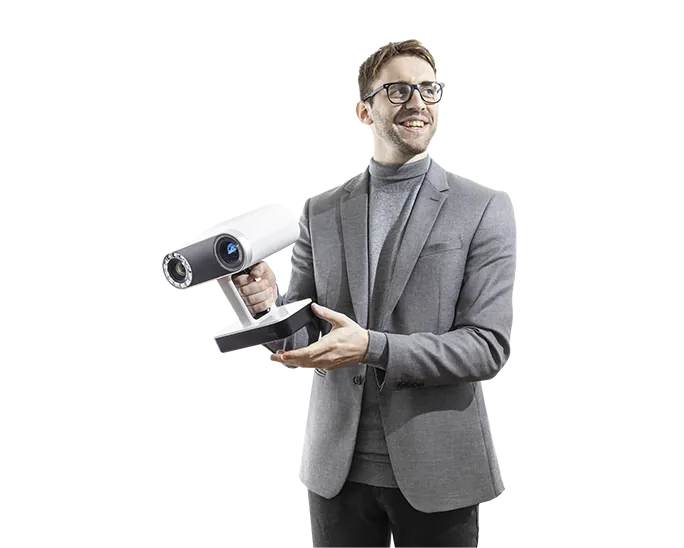
A professional scanner is a measuring instrument. Artec Leo states up to 0.1 mm point accuracy, Spider II 0.05 mm, Ray II 1.9 mm at 10 metres — figures measured under stated conditions on calibrated devices. Artec Studio keeps the raw scans and the processing history. When an expert is asked "how accurate is that?", there is an answer.
The practical rule is simple. If the model is for orientation, a phone is fine. If any number from it will be stated in a report or a courtroom, it needs a validated, disclosed method behind it — and a device with a published specification makes that far easier.
See a phone scan and a professional scan of the same object, measured side by side — book a demo.
Book a demoQuestions practitioners ask
Is phone LiDAR getting good enough?
It is getting better, and some forensic validations report errors of a few millimetres with specific apps. It still has no stated accuracy, no calibration and no traceability from the manufacturer, so each use has to be validated by the unit and disclosed — which matters more for evidence than the resolution of the picture.
Can we use a phone scan at all?
For orientation, briefing and planning, yes. As the source of a measurement that will be stated, only with a method your unit has validated and will disclose.
What does "stated accuracy" mean?
A figure the manufacturer publishes, measured under stated conditions on a calibrated device — the figure an expert cites and the opposing expert tests.
Is a professional handheld much harder to use?
Leo has a screen and processes onboard, so capture basics are taught in a day. What it adds is not complexity but a specification.
Tell us about the work you do
A forensic application specialist will come back with the device that fits it, the accuracy to expect at that scale, and how the data reaches your existing workflow.