
Crash Vehicle Scanning
Crush depth, deformation profile, intrusion into the cabin — the damage numbers a reconstruction runs on are all geometry, and a tape measure against a bent panel gives them a wide margin.
3D scanning records the vehicle as measured form, inside and out — the exterior or the interior in under an hour — so deformation is compared against undamaged geometry rather than estimated.
 No sensitive case details required.
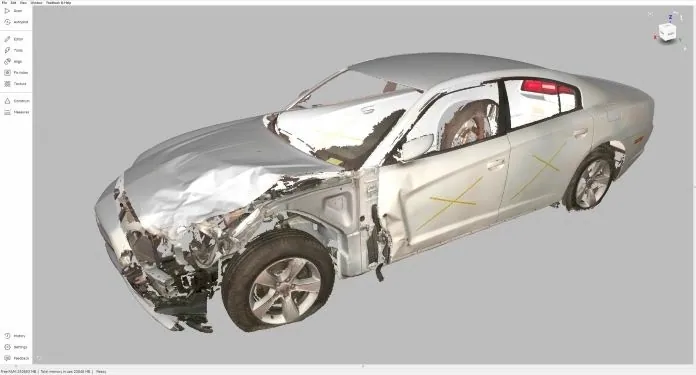
What does a 3D scan of a crashed vehicle give you?
A measurable model at up to 0.1 mm — crush profiles at any station, intrusion measurements and the deformed shape for comparison against an undamaged exemplar — with the exterior or the interior captured in under an hour.
 Inside and outExterior deformation and cabin intrusion in one model.
 Crush at any stationProfiles taken wherever the analysis needs them, afterwards.
 No contact with deformed metalSharp edges and unstable panels recorded from a distance.
 Under an hourAgainst three to four hours with a tripod laser scanner, in the Origin Forensics case.
Why hand measurement of a crashed vehicle is the weak link
Crush measurement by hand means a tape against a deformed surface at a handful of stations, chosen at the time. Every reading depends on where the tape touched and how the operator read it, and a station nobody measured cannot be added later. On a vehicle that has been recovered to a yard, the geometry may also have changed in transit.
Artec Leo records the whole vehicle at up to 0.1 mm without cables or a laptop, so an operator works around and inside it freely; HD Mode holds detail on dark and glossy paint, while glass needs a scanning spray. The model is compared against an undamaged exemplar to give crush at any station, and intrusion measured to any point in the cabin. The crush profiles feed the energy and delta-v (change in velocity) calculations the reconstruction runs on.
Origin Forensics captured vehicles this way and reported vehicle scans falling from three to four hours to under one. The model is the record — measured again whenever the analysis asks a new question.
The workflow, end to end
Whole vehicle first, then the detail that matters for the analysis.
- 1. Capture the exteriorWalk the vehicle with the handheld; coverage confirmed on screen.
 2. Capture the interiorCabin, footwells and intrusion zones, wirelessly, without a laptop to drag through the door.
 3. ProcessFuse into a model in Artec Studio, with up to 0.1 mm point accuracy.
- 4. Measure crushCompare against undamaged geometry; take profiles at any station.
 5. ExportInto the reconstruction or simulation package, as a mesh or point cloud.
Which scanner for this work
A vehicle is a handheld job. The second device is for the rare case where the whole scene is needed too.
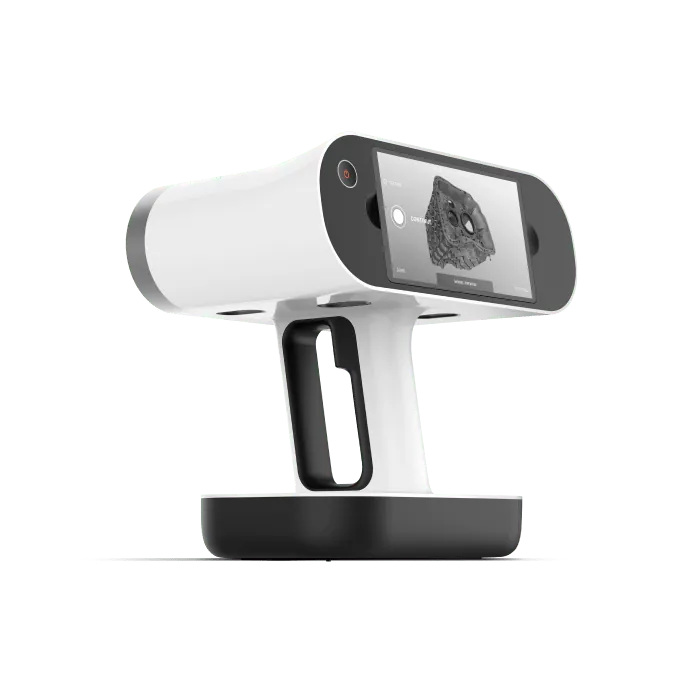
Artec Leo
- Best for
- The whole vehicle, inside and out
- 3D point accuracy
- Up to 0.1 mm
- 3D resolution
- Up to 0.2 mm
- Capture
- Wireless, screen and processing onboard
- Capture speed
- Up to 35 million points/s (HD Mode)
- Typical time
- A vehicle's exterior or interior in under an hour
Leo captures a vehicle at up to 0.1 mm wirelessly, with processing and screen onboard. No laptop, no cables — the operator gets into the cabin and under the wheel arch. HD Mode handles the dark, glossy surfaces that defeat many optical scanners.
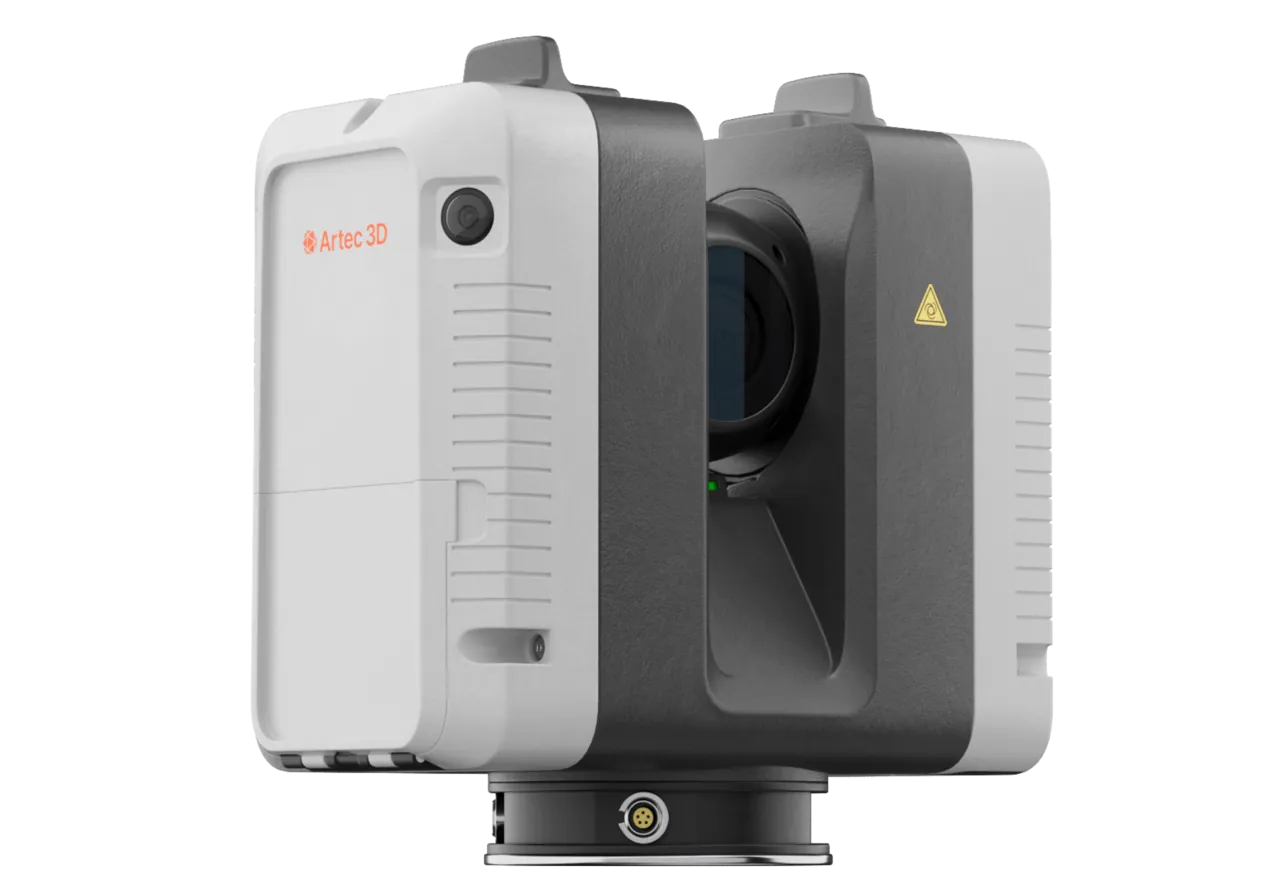
Artec Ray II
- Best for
- The vehicle in its scene
- Accuracy
- 1.9 mm at 10 m
- Range
- 0.5–130 m
- Scan time
- About 1.7 minutes per position (2.7 with colour)
- Portability
- Wireless, tripod-mounted
Where rest position and the roadway matter as much as the vehicle, Ray II records the scene from a tripod in about 1.7 minutes per dome, and the Leo vehicle scan registers into it.
See crush and intrusion measured on a scanned vehicle instead of a tape — book a demo.
Book a demoQuestions practitioners ask
How long does a vehicle take?
Under an hour for a vehicle's exterior or interior in the documented Origin Forensics work, against three to four hours with their previous tripod laser scanner.
Can crush be measured at a station we did not think of at the time?
Yes. The whole surface is recorded, so a profile is taken wherever the analysis later needs it.
Does it capture dark paint and glass?
HD Mode on Leo is built for black and shiny surfaces, including dark and glossy paint. Glass is the hard case for any optical method and needs a scanning spray.
What format does the reconstruction package need?
Artec Studio exports OBJ, PLY, STL, E57 and others, so the vehicle geometry goes into the software you already validate.
Tell us about the work you do
A forensic application specialist will come back with the device that fits it, the accuracy to expect at that scale, and how the data reaches your existing workflow.